
FAA Regulation
The FAA treats commercial drone operations with the same regulatory seriousness as manned aircraft. For businesses that hire drone pilots, understanding what the law requires isn't optional — it's basic due diligence. Here is what Ed Rich complies with on every commercial flight, and what an unlicensed operator simply cannot offer.
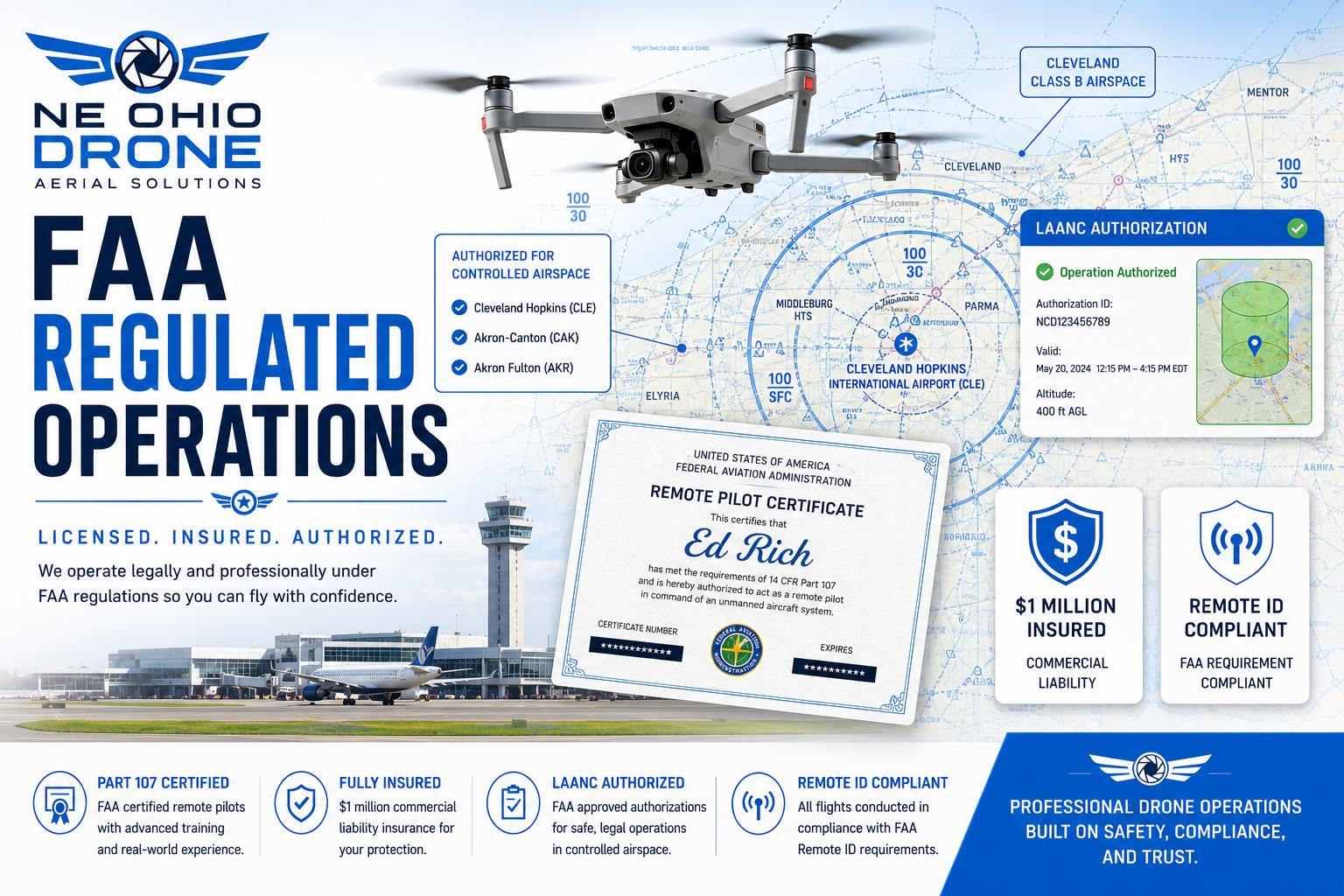
What FAA Compliance Requires on Every Flight
The FAA sets hard requirements for commercial drone operations under Part 107. These are not suggestions — operating outside these rules is a federal violation:
| Requirement | What It Involves | What This Means for You |
|---|---|---|
| Recurrent Knowledge Testing | Part 107 pilots must pass a recurrent aeronautical knowledge exam every 24 months covering current regulations, airspace changes, and operational procedures | Ed Rich holds a current, active certificate — not one that lapsed years ago |
| Remote ID — Now Enforced | All drones over 250 grams must broadcast their ID, location, altitude, and speed in real time during flight. Actively enforced federal law | Every flight Ed conducts is fully trackable and accountable to FAA standards |
| Flight Over People | Requires FAA authorization under Part 107 Subpart D with specific aircraft categories and documentation filed in advance | Events, crowded job sites, and busy intersections can be covered legally and safely |
| Night Flight | Commercial operations after sunset require anti-collision lighting visible for at least 3 statute miles. Standard drone LEDs do not meet this threshold | Dusk shoots, evening events, and after-hours inspections are all within scope |
| Controlled Airspace Authorization | Operating near airports requires LAANC authorization obtained before takeoff. Ed Rich is trained to identify airspace classifications and comply with all ATC requirements | Projects near Cleveland Hopkins, Akron-Canton, Burke Lakefront, or any controlled airspace can be handled legally |
| Commercial Liability Insurance | Ed Rich carries $1 million in commercial UAS liability insurance on every flight — specifically covering commercial operations, not recreational policies that become void for commercial use | You are protected if something goes wrong. An unlicensed pilot leaves you exposed |
Why These Rules Keep Changing
What This Means If You Hire an Unlicensed Pilot
None of the compliance items above apply to an unlicensed operator. They cannot legally obtain LAANC authorization, their insurance is void for commercial use, they are not tested on current regulations, and Remote ID compliance on consumer drones is not guaranteed. The liability for any violations or incidents doesn't rest solely with the pilot — it can extend to the business that hired them.
Ed Rich complies with every applicable FAA regulation on every flight. That includes pre-flight airspace checks, weather evaluation, Remote ID broadcast, proper lighting for the conditions, and insurance coverage from takeoff to landing. No shortcuts, no exceptions.